Start with communities, not a velvet rope
Disco emerged through overlapping nightlife networks rather than one inventor or opening night. Black, Latino and LGBTQ+ dancers were central to those networks, especially in New York. Soul, funk, Latin percussion and other musical currents met in rooms where a DJ could discover that a particular passage held people together.
David Mancuso’s Loft parties, which began in 1970, are an important reference for attentive listening, hospitality and sound. Nicky Siano’s Gallery and the work of Francis Grasso offer other perspectives on how selection and mixing developed. These were distinct people and settings, not interchangeable names for a single scene.
Studio 54 became a powerful public image of disco, but celebrity nightlife is only part of the picture. If the story begins and ends with its door policy, it loses the neighborhood spaces, record shops, musicians and dancers who made the culture possible.
Hear several sounds inside the word
Philadelphia is essential to understanding disco’s orchestral vocabulary. Kenny Gamble, Leon Huff, Thom Bell and the musicians associated with Philadelphia soul helped create records where rich arrangements and rhythmic drive worked together. MFSB’s “TSOP (The Sound of Philadelphia)” is a useful listening reference for that combination.
Elsewhere, different production choices expanded the possibilities. Donna Summer’s “I Feel Love,” produced by Giorgio Moroder and Pete Bellotte, placed a tightly sequenced electronic pulse at the center. Chic, led by Nile Rodgers and Bernard Edwards, demonstrated the extraordinary force of interlocking guitar, bass and rhythmic precision.
Listen to these recordings for contrasts rather than ranking them as more or less authentic. Follow a bass line through a verse, notice when strings enter, then hear what changes when the arrangement strips back. Disco can be lush, sparse, playful, searching or mechanically insistent.
A few eras, without hard borders
- Early 1970s / Rooms and discoveryPrivate parties and clubs brought diverse records into dialogue. A song did not need a “disco” label to become important to dancers.
- Mid-to-late 1970s / ExpansionLonger mixes, twelve-inch singles and international hits gave DJs and producers more space to shape musical journeys. Mainstream visibility also encouraged oversimplification.
- 1980s onward / ContinuitiesBoogie, post-disco and emerging house scenes carried forward different aspects of the sound. A change in marketing language did not mean dance-floor culture vanished.
Chicago’s Warehouse and Frankie Knuckles are central references in the development of house. In New York, Larry Levan’s work at the Paradise Garage illustrates another influential approach to sound and selection. Neither story is simply “disco with a new name”; local communities and new technologies mattered.
The DJ works with time
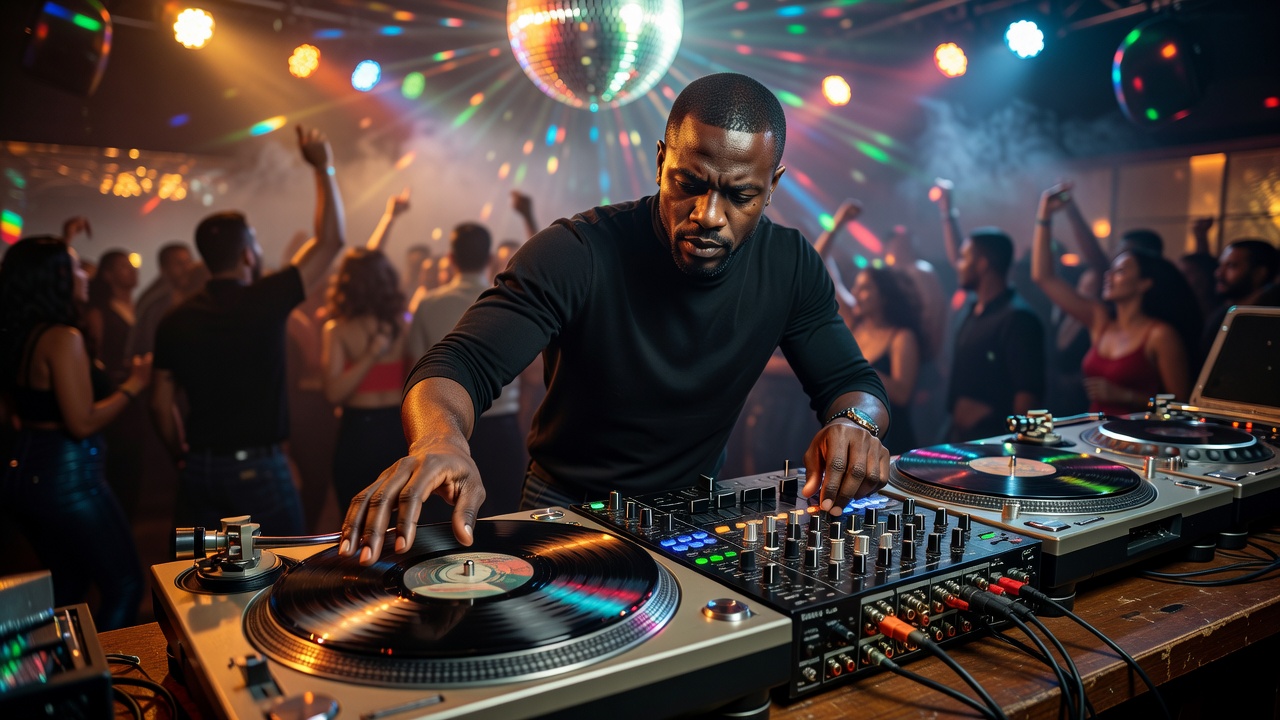
A DJ can extend anticipation, soften a transition or change the emotional direction of a night. Beatmatching is one technique, but not the whole craft. Selection, sequencing and knowing when not to blend are equally significant. A technically smooth transition can still feel wrong if it ignores the atmosphere.
For a beginner listening exercise, choose three records with different textures. Imagine which one should arrive first, what each ending leaves unresolved and whether the next introduction answers it. You are practicing musical programming, even without touching a mixer.
A small DJ glossary
- Phrase
- A musical section that helps a DJ recognize where an introduction, change or transition may make sense.
- Beatmatching
- Aligning the tempo and beat timing of two recordings so they can overlap rhythmically.
- Blend
- A transition in which recordings overlap; the duration and purpose vary.
- Edit
- A rearrangement of an existing recording, often changing its structure for listening or dancing.
- Remix
- A new interpretation that may alter instrumentation, arrangement and production more substantially.
- Break
- A passage where parts drop away, often exposing percussion or creating tension before a return.
Keep exploring beyond the famous chorus
Tim Lawrence’s Love Saves the Day and Bill Brewster and Frank Broughton’s Last Night a DJ Saved My Life offer substantial routes into dance-music history. Read alongside interviews, label credits and archival recordings; no single account represents every city or community.
When a contemporary track catches your ear, investigate its credits and influences. That habit turns nostalgia into curiosity. It also helps you recognize the musicians and scenes behind a sampled phrase rather than treating the past as an anonymous box of sounds.
Build a night with an actual musical arc
Connect your references to welcoming, present-day hosting →